When Lauren Morales started taking on more prominent roles at TomKats Hospitality, the company her father started, she found herself in male-dominated room after male-dominated room. So she looked to Layla Vartanian, owner of the eponymous Layla’s Honky Tonk, for guidance.
“Layla is my favorite person on the planet,” says Morales. “She’s been a good mentor to me for leadership roles on the Broadway Entertainment Association. She’s not afraid to speak up, even when there are big players in the room. When you’re sitting in a room with a lot of powerful men, it can sometimes feel like you’re not supposed to speak up. Watching her speak up gave me the confidence to speak up more in those rooms.”
For decades, Vartanian was one of the only women who owned an independent music venue in the city, and thus the only woman in rooms like those Morales describes. But that’s changing. After working with their father Tom Morales for years, Lauren and her sister Kendall Morales officially took over the TomKats business from him, and now they helm Acme Feed & Seed and the company’s other businesses. Women-owned music venues are increasing in number on Broadway and beyond. There are honky-tonks, concert halls, intimate bars and even a live-music karaoke joint. While they are still vastly outnumbered by male-owned venues, these venues are shaping the city’s music scene.
Women ownership of music venues is not new to Nashville. One of the most famous venues in the city was once owned by a woman, and it was under her tenure that it cemented its spot in music history. Hattie Louise “Tootsie” Bess bought a bar on Broadway that was then called Mom’s and turned it into Tootsie’s Orchid Lounge, a venue that helped launch countless careers. Bess was known for her soft side — giving down-on-their-luck musicians $5 or a beer (or both). She was also known for her hard side, famously sticking ill-behaved patrons with a sharp hat pin given to her by Charley Pride. Tootsie’s is no longer woman-owned (Bess died in 1978, and Lower Broadway magnate Steve Smith purchased it in the early 1990s), but Bess’ legacy cannot be overstated.
Today’s venues vary in size, scope, purpose, genre and ownership structure, but there are common connective threads. All of these women entrepreneurs have clarity on their core values and how those values are present in their businesses. Across the board, the women who run these venues report having low employee turnover — many working with friends and family for decades, even in an industry and an economic environment of high turnover. They are committed to uplifting other women, as partners and employees, booking more female acts with female promoters, and otherwise offering opportunities where there historically have been limits. AB Hillsboro Village’s support of teenage guitar phenom Grace Bowers is one example. Drkmttr’s everyone-is-welcome-here ethos is another.
Legendary country singer Trisha Yearwood says, “It is 100 percent important to have women-owned and women-led music venues. Women should be ruling the world. We should be given a shot. You know, guys haven’t been doing that great of a job.”
Citing the management of Camille Tambunting — COO of Strategic Hospitality, Garth Brooks and Yearwood’s partner in their Friends in Low Places Bar & Honky Tonk — Yearwood sees the role of women in creating a venue that prioritizes being a good neighbor, whether that means increasing recycling and sustainability initiatives, building extra space to manage crowds in the room design or even funding a police substation next door.
The official federal definition of a woman-owned business is a small business that is at least 51 percent owned and controlled by one or more women who are U.S. citizens. We’re defining “woman-owned” as a venue where at least one woman has an ownership stake and is involved in its operations. This excludes businesses where women are silent investors, or where female managers are in charge of operations but don’t have an ownership stake. (The previous woman ownership at The Bluebird Cafe — founded by Amy Kurland in 1982 — has been noted as a factor in Taylor Swift’s road to stardom. Today the iconic spot is owned by the Nashville Songwriters Association International and managed by a woman, Erika Wollam-Nichols.) We’ve excluded businesses that merely license a female performer’s name, such as Lainey Wilson’s Bell Bottoms Up Restaurant & Bar. And we’re defining “music venue” loosely as any venue that hosts live musicians performing as a significant part of its operations. This excludes the occasional open-mic night in a bookstore or coffee shop.
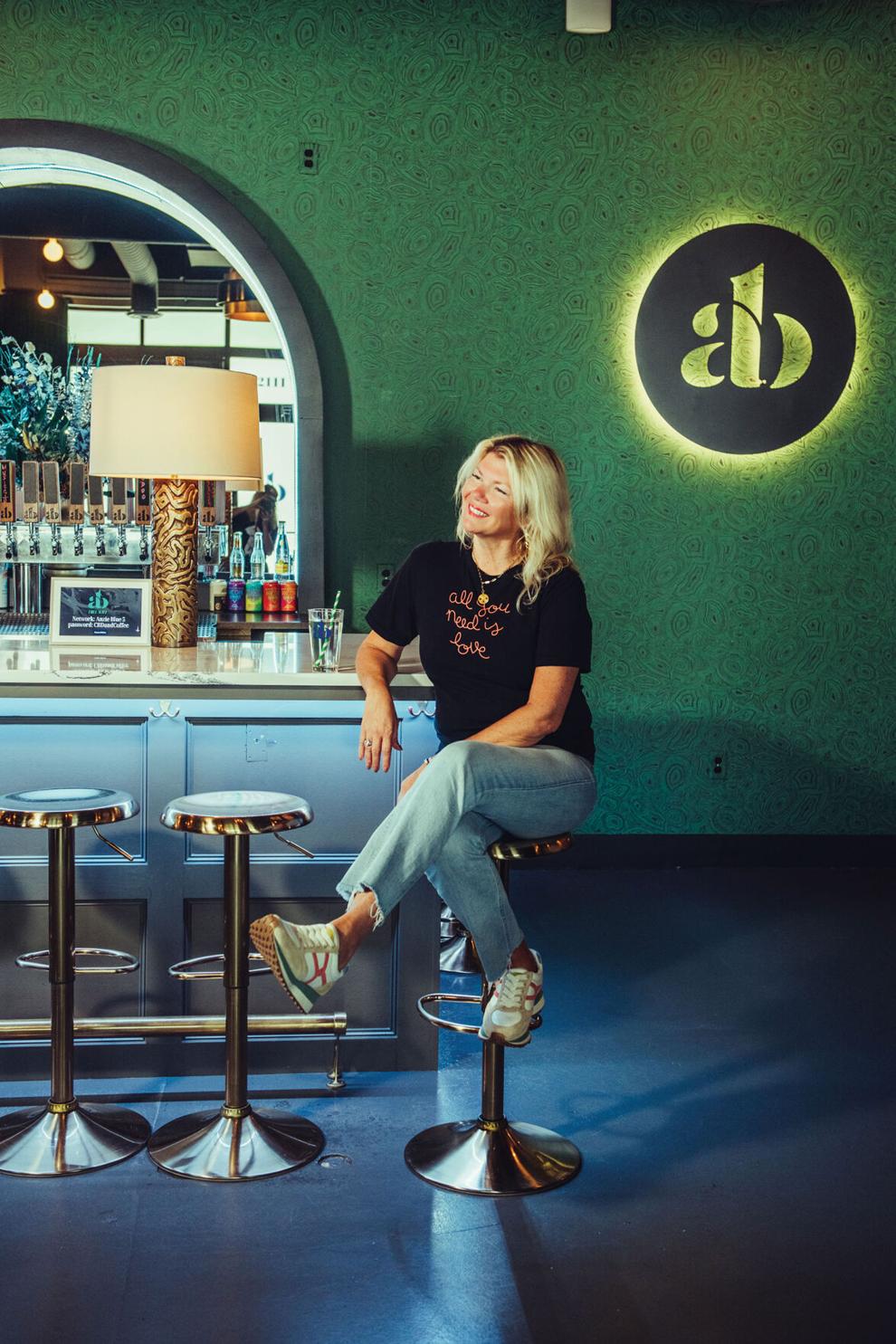
When Marcie Allen Van Mol and her husband Derek recast their former restaurant Anzie Blue as AB Hillsboro Village, the Nashville natives wanted to create a live music and event venue by locals, for locals. Van Mol, who has worked in the music industry in different capacities for decades (she once owned the late, great downtown music festival Dancin’ in the District), saw an opportunity to provide a space for performers and events that had trouble booking elsewhere. Since March 2023, AB Hillsboro Village has hosted 250 events, including a prom for a nonbinary teen who was turned away from their senior prom at Nashville Christian School. The prom was an unexpected collaborative event, and it raised AB Hillsboro Village’s profile as a place that supports progressive causes. (Disclosure: Van Mol is the niece of Bill Freeman, who owns Scene parent company FW Publishing.)
Those kinds of causes also are behind Dickerson Pike all-ages venue Drkmttr. Olive Scibelli, co-owner of Drkmttr, describes the venue as a “third place” — where musicians, other artists and kids too young to get into other venues can experiment and perform in a safe place. Drkmttr has “zero tolerance” for harassment in its space, where community building is paramount. The leftist political beliefs of those involved are “baked in our culture,” Scibelli says. That means they fly rainbow flags, and ACAB is graffitied in the bathrooms.
“Drkmttr exists because Lucy’s existed,” says Scibelli, referring to Lucy’s Record Shop. The now-legendary 1990s Nashville record shop and all-ages club morphed into a community center for people with shared values, promoting free speech and free expression.
“As more women started coming there, the level of feminist engagement increased because of the people who came there,” remembers Mary Mancini, who was one of the owners of Lucy’s. She’s also a longtime supporter of independent music and independent thought. “As the kids and the young women [who played at Lucy’s] got older and got out into the world, they took those experiences and they informed how they went out into Nashville. The bubble expanded eventually.”
Mancini and her husband Kurt Wagner of the band Lambchop learned about Drkmttr through Donnie and April Kendall, who had been partners in Lucy’s. Donnie was helping Drkmttr find a new building and asked the couple if they were interested in buying a building to make sure Drkmttr thrives. “These places are not just doing the work of adding to the incredible culture of live music,” says Mancini, who now serves on the Drkmttr board. “They’re continuing to pave the way and move forward and make space for other people to feel comfortable.”
Scibelli and her business partner Kathryn Edwards are applying to make Drkmttr a 501(c)(3) nonprofit. They feel that designation will help secure the 10-year-old venue’s future. It’s tough, Scibelli says, to run a venue and make “a living wage in a city that is growing.” Vartanian bought her honky-tonk in 1997 for $5,000, which she put on a credit card. Owning a business is a lot more expensive these days, with small independent venues competing against corporations with deeper pockets for rent, advertising and to pay musicians.
“Corporations should not own small music venues,” says Chris Cobb, president of the Music Venue Alliance Nashville. “It is not mission-focused on that point.”
Like many venue owners (including AB Hillsboro Village’s Van Mol and The Bowery Vault’s Emily Zimmer), Scibelli has a day job — she’s a hairstylist, and Edwards is a tour manager. “I would not tell a kid to be a venue owner,” Scibelli laughs. Even so, she says she knows the work she and other women do matters to girls and young women.

East Side all-ages venue also releasing benefit comp
“It is important [that] the representation ([which] everyone pats themselves on the backs for platforming, when it happens) is included in all aspects of the live music process for true diversity,” Edwards says via email while out on tour. “To me, it is silly to cheer on a woman being a musician and gatekeep access to roles outside of the performer. This is an important issue in my own life as a Black woman, the least-seen face within the music industry off the stage. Compare it to the question of how football leagues could be so largely Black but have such a low percentage of [Black] quarterbacks and coaches in their ranks?”
For his part, MVAN’s Cobb is optimistic that things are improving. When he owned and operated venues (including Exit/In), “it used to be all dudes backstage — maybe there was one woman on a crew. That has completely shifted for the better.” He cites the recent Greater Nashville Music Census, which found that 49 percent of respondents in the venue-presenter track were female and 55 percent of respondents in the industry track were female. Just 26 percent of those in the creative track were women, so there is room to grow on the performing and songwriting side.
The Nashville Independent Venues Study produced for Metro Nashville Planning earlier this year cited training and supporting a diverse group of next-generation independent venue owners as one priority for the city’s economic development.